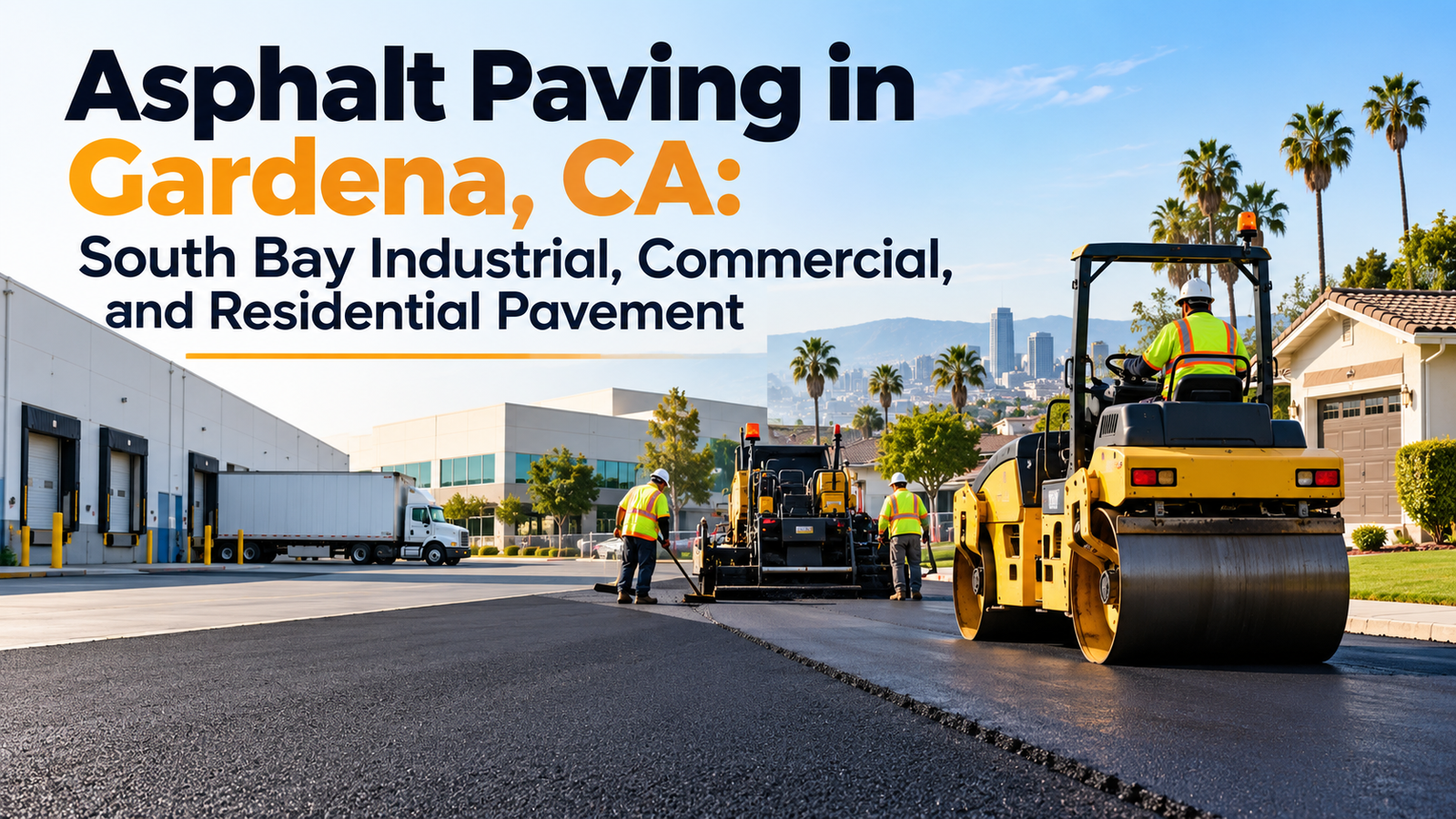
Gardena is a mid-sized city in the South Bay area of Los Angeles County, occupying a compact footprint bounded by Hawthorne, Inglewood, Compton, Torrance, and Lawndale. The city’s character reflects its position as an inner-ring industrial and commercial hub in the densely developed southwest LA basin: a mix of light industrial uses, commercial strips, auto-related businesses, multi-family residential development, and older single-family neighborhoods. Its central location between the 405 Freeway corridor and the 110 Harbor Freeway makes it a significant logistics and light manufacturing address in the South Bay.
Asphalt Contractor Gardena paving in Gardena operates in a specific Southern California climate context mild temperatures relative to the Inland Empire, significant marine influence from the Pacific, and enough seasonal variation to drive pavement aging overlaid on the specific land use pattern of an industrial-commercial city where heavy vehicle traffic is a constant and pavement demands in commercial and industrial zones exceed those in residential applications.
Southern California’s Climate and Asphalt in the South Bay
Gardena’s coastal-influenced climate is significantly more moderate than the Inland Empire cities to the east. The marine layer from the Pacific moderates summer temperatures, keeping the Gardena area 15 to 25 degrees Fahrenheit cooler than Riverside on typical summer days. Pavement surface temperatures in Gardena rarely exceed 130 degrees Fahrenheit, compared to 150 or higher in the Inland Empire. This has direct implications for mix design: while PG 64-16 or PG 70-10 binder grades are commonly specified in the South Bay, the extreme PG 76-22 grades used in hotter inland areas are not required.
However, the South Bay’s climate is not without its own pavement challenges. Fog and marine layer moisture create periodic wet conditions that infiltrate cracked pavement surfaces throughout the year, not just in the winter rain season. Morning dew condensation on pavement in summer and fall contributes to moisture in the pavement structure. While the annual precipitation in Gardena (approximately 13 inches) is modest, the year-round moisture from coastal influence keeps pavement crack infiltration active in ways that are different from drier inland areas.
UV radiation in the South Bay is significant despite the marine moderation. Coastal Southern California receives intense UV exposure, and asphalt binder oxidation is a meaningful deterioration factor. Sealcoating in Gardena delivers the same UV-blocking benefit as in hotter climates, and the recommended application interval of two to three years reflects the coastal California climate rather than the more frequent intervals appropriate for the Inland Empire.
Industrial and Commercial Pavement Demands in Gardena
Gardena’s light industrial zones concentrated in the western and central portions of the city along Western Avenue, Normandie Avenue, and the industrial corridors west of the 110 Freeway generate significant heavy vehicle pavement loading. Warehousing and distribution facilities attract daily traffic from semi-trucks and delivery vehicles with axle loads that can be ten to twenty times those of passenger cars. Pavement designed to standard light-duty specifications fails prematurely under this loading.
Industrial pavement in Gardena is typically designed with a structural section that reflects the expected truck traffic loading. Six to eight inches of aggregate base, topped with four or more inches of asphalt in multiple lifts, is standard for truck access drives and dock aprons in the Gardena industrial zones. Areas at truck turning points and dock approach zones receive additional structural section because the concentrated loads from slow-moving trucks turning at these locations are the most damaging loading pattern for flexible pavement.
Auto-related businesses dealerships, repair shops, detailing operations are prominent along Gardena’s commercial corridors. These businesses generate specific pavement demands: oil and fuel spills that degrade asphalt binder, hydraulic fluid leaks from vehicles being moved on transport dollies, and in dealership settings, high volumes of car transport trucks delivering new vehicle inventory. Chemical-resistant sealcoat formulations and concrete aprons at spill-prone locations are part of the pavement maintenance strategy for auto-related commercial properties.
Residential Paving in Gardena’s Established Neighborhoods
Gardena’s residential neighborhoods particularly in the older sections east of Vermont Avenue have an inventory of mid-century driveways that are at or past the end of their original design life. Many of these driveways were installed in the 1950s through 1970s and have received intermittent maintenance but no full replacement. They show the accumulated effects of South Bay pavement aging: surface oxidation, transverse thermal cracking, edge raveling from the loss of lateral support, and in some cases alligator cracking from subgrade softening under years of irrigation moisture.
Driveway replacement in Gardena’s residential zones involves the same process as elsewhere in Southern California: stripping the existing surface and base to a clean subgrade, probing for soft spots in the subgrade, placing and compacting aggregate base, and installing a new asphalt surface to the design thickness. Standard residential driveways in Gardena use a four-to-five-inch aggregate base and two inches of asphalt surface course a section appropriate for passenger vehicle loading on the silty clay and alluvial soils common in the South Bay basin.
Gardena’s Soils and Their Effect on Pavement Performance
Gardena sits on the floor of the Los Angeles Basin, underlain by alluvial deposits of the Los Angeles River drainage system. These sediments are predominantly fine-grained silty clays, sandy clays, and clay-rich silts with moderate to high shrink-swell potential. The Dominguez Channel drains the area, and the proximity to historical wetlands means that some portions of Gardena have shallow groundwater and soft fine-grained soils at depth.
The expansive character of Gardena’s native soils means that pavement founded without adequate aggregate base separation will follow the soil’s seasonal moisture-driven volume changes. Summer drying contracts the soil, creating voids beneath pavement that may not be visible at the surface. Winter wetting expands it, creating upward pressure that can lift pavement sections slightly. The net effect over multiple cycles is differential settlement and surface irregularity that concentrates cracking at the points of greatest displacement.
Striping, ADA Compliance, and Parking Lot Standards in Gardena
Gardena’s commercial properties are subject to California’s Title 24 accessibility standards, which are more stringent than the federal ADA minimum requirements. Parking lots must provide a specified number of accessible spaces based on total capacity, with accessible stall dimensions, access aisles, and signage meeting California’s accessibility regulations. Van-accessible spaces require 9-foot width with an 8-foot access aisle.
California Title 24 also requires specific slopes for accessible routes and parking surfaces that are more restrictive than federal ADA standards. Pavement installed with slopes exceeding 2 percent in any direction in accessible parking areas violates California accessibility requirements, and enforcement by local building departments and through ADA litigation is active in the LA County area. New pavement installations and resurfacing projects in commercial Gardena should include accessible parking area grade design that meets the California Title 24 standard.
Frequently Asked Questions: Asphalt Paving in Gardena, CA
What asphalt binder grade is used for Gardena pavement?
PG 64-16 or PG 70-10 performance-graded binder is typically specified for South Bay coastal California. The more extreme PG 76-22 grade used in hotter inland areas is not required in Gardena’s moderate climate.
Why do industrial parking lots in Gardena need heavier pavement sections?
Semi-truck and delivery vehicle axle loads can be ten to twenty times those of passenger cars. Pavement designed for light-duty use fails rapidly under this loading. Industrial and logistics facilities require structural sections six to eight inches base with four or more inches asphalt specifically designed for the expected truck traffic.
How does marine moisture affect Gardena asphalt differently than rain?
Marine fog, morning dew, and coastal air moisture keep pavement crack infiltration active year-round, not just during the winter rain season. This year-round moisture exposure means that crack sealing is as important in summer as in fall preparation for the rainy season.
What are California Title 24 accessibility requirements for Gardena parking lots?
California Title 24 is more stringent than federal ADA. Required accessible stall counts, dimensions, and pavement slopes in accessible areas meet the California standard, which limits cross-slopes to 2 percent in any direction in accessible parking.
How do petroleum spills from auto businesses affect Gardena pavement?
Oil, fuel, and hydraulic fluid degrade asphalt binder by dissolving the bituminous cement. Chemical-resistant sealcoat formulations and concrete aprons at spill-prone areas (drains, drain plugs, drip areas) help protect pavement from chemical degradation in auto-related commercial properties.
Asphalt paving in Gardena serves a city with a distinctive character: South Bay industrial intensity, auto-industry concentration, established residential neighborhoods, and a climate that is gentler than the Inland Empire but no less demanding of proper installation and maintenance. Professional asphalt work in this context understands both the heavy pavement demands of the commercial and industrial zones and the residential maintenance needs of mid-century neighborhoods that have been waiting decades for updated surfaces.